Get a JWT Authentication Token
Use this guide to get a JWT access token for FormKiQ API requests. Most API examples in the documentation require this token in the Authorization header.
Before You Begin
Confirm you have:
- A deployed FormKiQ environment.
- Access to the AWS account and Region where FormKiQ is deployed.
- Access to the FormKiQ administrator username and password.
- cURL or an API client such as Postman.
- Optional: jq for formatting JSON responses.
Variables Used
| Placeholder | Description |
|---|---|
COGNITO_API_ENDPOINT_URL | Cognito API endpoint from the FormKiQ CloudFormation stack outputs, including https://. |
HTTP_API_URL | FormKiQ API endpoint from the CloudFormation stack outputs, including https://. |
USERNAME | FormKiQ administrator email address. |
PASSWORD | FormKiQ administrator password. |
AUTHORIZATION_TOKEN | Access token returned by the login request. |
The examples below use shell variables. Replace the values before running the commands:
export COGNITO_API_ENDPOINT_URL="https://your-cognito-api.example.com"
export HTTP_API_URL="https://your-formkiq-api.example.com"
export USERNAME="admin@example.com"
export PASSWORD="your-password"
Step 1: Find the Cognito API Endpoint
Open the AWS CloudFormation console, select your FormKiQ stack, and open the Outputs tab.
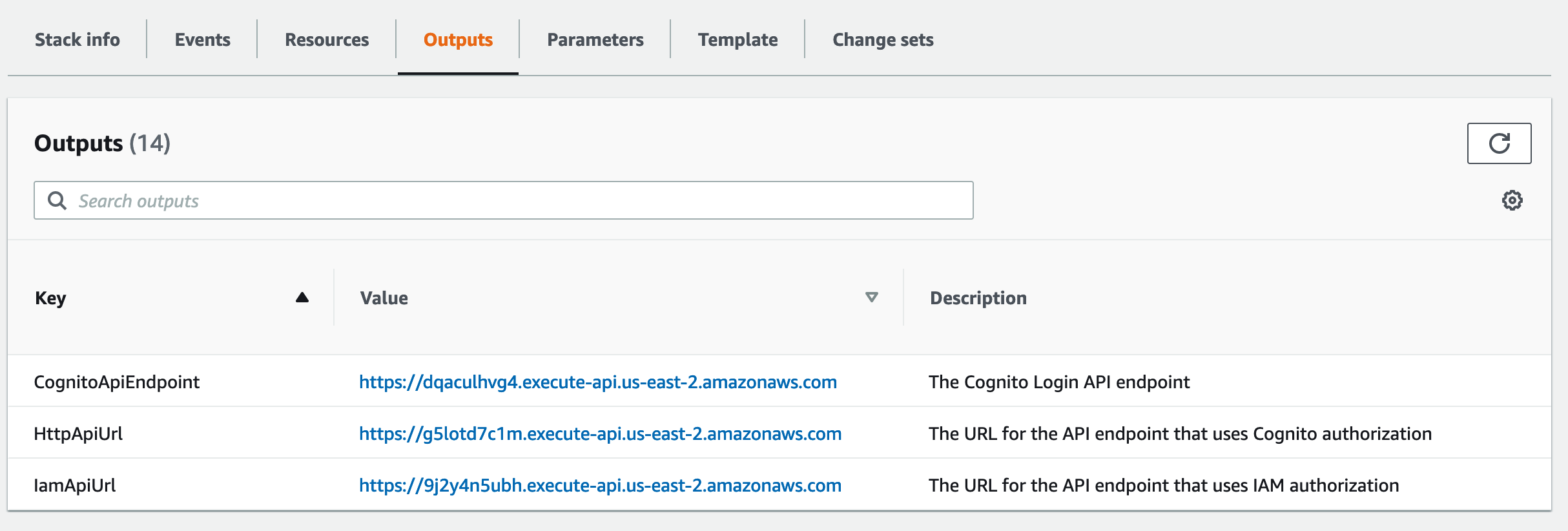
Find the CognitoApiEndpoint output. Use that value as COGNITO_API_ENDPOINT_URL.
If you want to verify the token with the FormKiQ API, also record the HttpApiUrl output as HTTP_API_URL.
Step 2: Request an Access Token
Send a login request to the Cognito API endpoint.
curl -X POST "${COGNITO_API_ENDPOINT_URL}/login" \
  -H "Content-Type: application/json" \
  -d '{"username": "'"${USERNAME}"'", "password": "'"${PASSWORD}"'"}'
A successful response includes an AccessToken.
{
  "AuthenticationResult": {
    "AccessToken": "eyJraWQiOiJkdkpnTHlm...",
    "ExpiresIn": 86400,
    "TokenType": "Bearer",
    "RefreshToken": "eyJjdHkiOiJKV1Qi...",
    "IdToken": "eyJraWQiOiI5YUpvb..."
  }
}
Use the AccessToken value as AUTHORIZATION_TOKEN in FormKiQ API requests. Do not use the IdToken for FormKiQ API authorization.
export AUTHORIZATION_TOKEN="eyJraWQiOiJkdkpnTHlm..."
The access token is valid for a limited time. If API requests start returning 401 Unauthorized, request a new token.
Verify the Result
Use the token with GET /sites to confirm that the JWT is valid and that the user has FormKiQ site access.
curl -X GET "${HTTP_API_URL}/sites" \
  -H "Authorization: Bearer ${AUTHORIZATION_TOKEN}"
The request should return the sites available to the authenticated user.
{
  "sites": [
    {
      "siteId": "default",
      "permission": "READ_WRITE"
    }
  ]
}
Troubleshooting
| Problem | Likely cause | What to check |
|---|---|---|
401 Unauthorized | The token is expired, missing, or not an access token. | Request a new token and use the AccessToken value. |
403 Forbidden | The user is authenticated but does not have permission for the requested API action. | Check FormKiQ user groups and permissions. |
404 Not Found on /login | The wrong endpoint was used. | Confirm you are using CognitoApiEndpoint, not HttpApiUrl. |
GET /sites fails | The request is using the wrong API URL or token format. | Use HttpApiUrl and send Authorization: Bearer <AccessToken>. |
| API call uses the wrong token | The IdToken was used instead of the AccessToken. | Use AuthenticationResult.AccessToken for API authorization. |
| Login request fails | Username, password, or deployment endpoint is incorrect. | Confirm the administrator credentials and CloudFormation output values. |