Add Documents
Use this guide to add documents to FormKiQ with the API. It covers inline text content, base64-encoded content, large file uploads, and retrieving a download URL.
Before You Begin
Confirm you have:
- A deployed FormKiQ environment. See Quick Start.
- cURL or an API client such as Postman.
- A JWT access token. See Get a JWT Authentication Token.
- Optional: jq for formatting JSON responses.
All shell commands are shown for Unix-based systems. Windows has analogous commands for each.
Variables Used
| Placeholder | Description |
|---|---|
HTTP_API_URL | FormKiQ API endpoint from the CloudFormation stack output, including https://. |
AUTHORIZATION_TOKEN | JWT access token used in the Authorization header. |
SITE_ID | Optional FormKiQ site ID. Use default unless your deployment uses multiple sites. |
DOCUMENT_ID | Document ID returned by FormKiQ. |
FILE_NAME | Local file name to upload. |
FILE_CONTENT_TYPE | MIME type for the uploaded file, such as application/pdf. |
BASE64_CONTENT | Base64-encoded document content. |
PRESIGNED_UPLOAD_URL | Temporary Amazon S3 upload URL returned by FormKiQ. |
DOCUMENT_DOWNLOAD_URL | Temporary document download URL returned by FormKiQ. |
The examples below use shell variables. Replace the values before running the commands:
export HTTP_API_URL="https://your-formkiq-api.example.com"
export AUTHORIZATION_TOKEN="your-jwt-access-token"
export SITE_ID="default"
Step 1: Find the FormKiQ API Endpoint
Open the AWS CloudFormation console, select your FormKiQ stack, and open the Outputs tab.
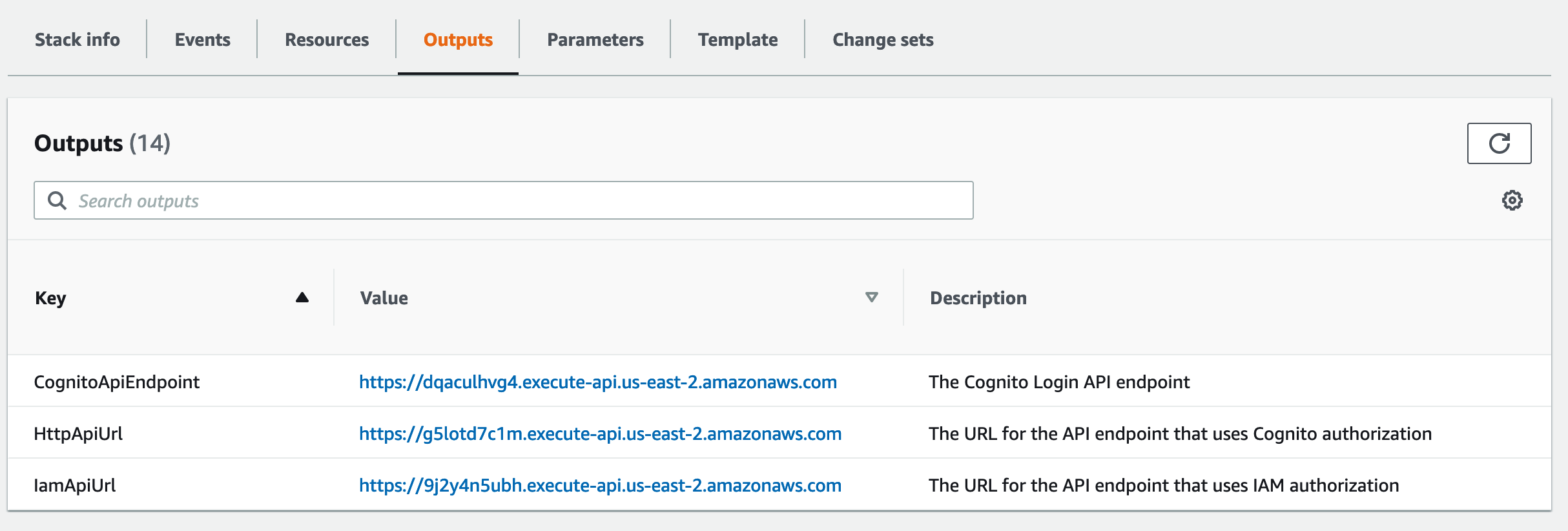
Use the HttpApiUrl output as HTTP_API_URL.
Step 2: Add a Text Document
Use POST /documents for small documents and inline content.
curl -X POST "${HTTP_API_URL}/documents?siteId=${SITE_ID}" \
  -H "Authorization: ${AUTHORIZATION_TOKEN}" \
  -H "Content-Type: application/json" \
  -d '{"path": "test.txt", "contentType": "text/plain", "content": "This is sample content"}'
A successful response returns a documentId. The response may also include the siteId.
{
  "documentId": "b18e0d3b-48cb-4589-ab5d-f19e27b44f05",
  "siteId": "default"
}
Step 3: Add a Base64-Encoded Document
Use base64 encoding when you need to send binary content directly in the API request body.
curl -X POST "${HTTP_API_URL}/documents?siteId=${SITE_ID}" \
  -H "Authorization: ${AUTHORIZATION_TOKEN}" \
  -H "Content-Type: application/json" \
  -d '{"path": "sample.pdf", "contentType": "application/pdf", "isBase64": true, "content": "BASE64_CONTENT"}'
A successful response returns a documentId.
{
  "documentId": "7e0aca55-f6b2-4b93-95df-c188691dcb99"
}
Step 4: Upload a Large Document
For larger documents, request an upload URL from FormKiQ and then upload the file bytes directly to Amazon S3.
curl -X POST "${HTTP_API_URL}/documents/upload?siteId=${SITE_ID}" \
  -H "Authorization: ${AUTHORIZATION_TOKEN}" \
  -H "Content-Type: application/json" \
  -d '{"path": "sample.pdf", "contentType": "application/pdf"}'
The response includes a presigned upload URL, a documentId, and may include headers that must be sent to Amazon S3.
{
  "url": "https://formkiq-core-dev-documents-XXXXXX.s3.us-east-2.amazonaws.com/05c1dc43-e9f3-4bb5...",
  "documentId": "05c1dc43-e9f3-4bb5-9732-077c02dac2c9",
  "headers": {}
}
Upload the local file to the returned URL. If the response includes headers, send those headers exactly as returned.
curl -v -H "Content-Type: FILE_CONTENT_TYPE" \
  --upload-file FILE_NAME \
  "PRESIGNED_UPLOAD_URL"
If the response includes S3 headers, add each returned header to the upload request:
curl -v \
  -H "Content-Type: FILE_CONTENT_TYPE" \
  -H "RETURNED_HEADER_NAME: RETURNED_HEADER_VALUE" \
  --upload-file FILE_NAME \
  "PRESIGNED_UPLOAD_URL"
Step 5: Get a Document Download URL
Use the documentId to request a temporary download URL.
curl -X GET "${HTTP_API_URL}/documents/DOCUMENT_ID/url?siteId=${SITE_ID}" \
  -H "Authorization: ${AUTHORIZATION_TOKEN}"
A successful response returns a URL for the document content.
{
  "url": "https://formkiq-core-dev-documents-XXXXXX.s3.us-east-2.amazonaws.com/05c1dc43-e9f3-4bb5...",
  "documentId": "05c1dc43-e9f3-4bb5-9732-077c02dac2c9"
}
Download the document content.
curl "DOCUMENT_DOWNLOAD_URL" --output sample.pdf
Verify the Result
Confirm the document was created by requesting its metadata.
curl -X GET "${HTTP_API_URL}/documents/DOCUMENT_ID?siteId=${SITE_ID}" \
  -H "Authorization: ${AUTHORIZATION_TOKEN}"
The response should include the document ID, path, content type, and related metadata.
Troubleshooting
| Problem | Likely cause | What to check |
|---|---|---|
401 Unauthorized | Token is missing or expired. | Get a new JWT access token. |
403 Forbidden | The user does not have permission to add or read documents. | Check FormKiQ user permissions. |
400 Bad Request | Request body is malformed or required fields are missing. | Check path, contentType, and JSON formatting. |
| Upload to S3 fails | Content type, presigned URL usage, or returned headers are incorrect. | Use the returned URL exactly, include returned headers, and keep the expected content type. |
| Download URL expires | Presigned URLs are temporary. | Request a new document download URL. |
| Document is not found in a multi-site deployment | The request used the wrong site. | Confirm SITE_ID or omit it only when using the default site. |